
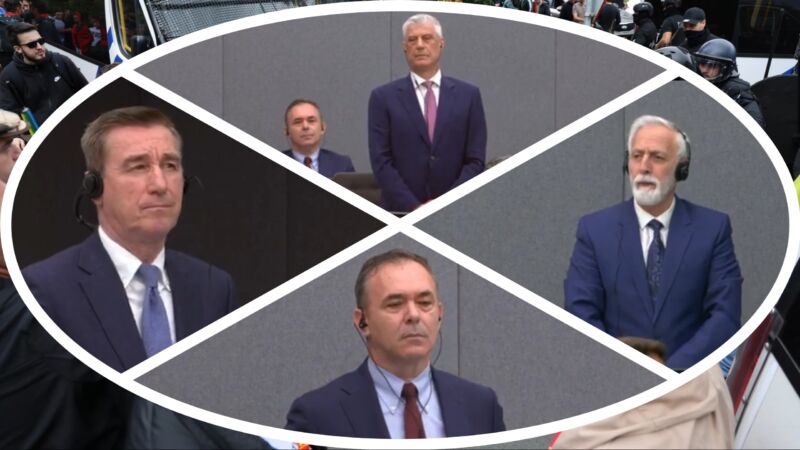
The judgment delivered on 16 September 2026 against Hashim Thaçi, Jakup Krasniqi, Kadri Veseli and Rexhep Selimi is one of the most consequential legal and political events in Kosovo’s post-war history.
The Trial Panel of the Kosovo Specialist Chambers found all four former Kosovo Liberation Army leaders guilty of the war crimes of unlawful or arbitrary detention, cruel treatment, torture and unlawful killing. At the same time, it acquitted them of all charges of crimes against humanity and of several alleged war-crime incidents that had not been proved beyond a reasonable doubt, had been subsumed under more specific charges or fell outside the court’s jurisdiction.
Thaçi and Krasniqi were each sentenced to 25 years’ imprisonment, Veseli to 18 years and Selimi to 13 years. The time they have spent in detention since November 2020 will be deducted from their sentences.
The judgment does not amount to a legal condemnation of the KLA as an organisation, nor does it determine the legitimacy of Kosovo’s war for liberation. It establishes the individual criminal responsibility of four men for specific criminal conduct that the court found proved beyond a reasonable doubt.
That distinction is central to understanding both what the court decided and what it did not.
The sentences and the charges
| Accused | Unlawful or arbitrary detention | Cruel treatment | Torture | Unlawful killing | Single sentence |
|---|---|---|---|---|---|
| Hashim Thaçi | 15 years | 4 years | 20 years | 23 years | 25 years |
| Jakup Krasniqi | 15 years | 4 years | 20 years | 23 years | 25 years |
| Kadri Veseli | 10 years | 3 years | 13 years | 16 years | 18 years |
| Rexhep Selimi | 6 years | 2 years | 8 years | 11 years | 13 years |
These individual sentences were not added together mechanically. Under the court’s rules, the Trial Panel first determined a sentence for each offence and then imposed a single sentence reflecting the accused’s criminal conduct as a whole.
The Panel found the four accused criminally responsible, through their significant contribution to a common criminal purpose, for the unlawful or arbitrary detention of at least 385 persons, the cruel treatment of at least 49 persons, the torture of at least 303 persons and the unlawful killing of at least 96 persons.
The Office of the Specialist Prosecutor had sought 45-year prison sentences for each accused. The final sentences therefore represent roughly 56 per cent of the requested punishment for Thaçi and Krasniqi, 40 per cent for Veseli and 29 per cent for Selimi.
The scale of the proceedings
The dimensions of the trial help explain why the full legal significance of the judgment cannot be reduced to the prison terms alone.
The proceedings involved 273 witnesses, 5,467 exhibits, 1,017 adjudicated facts, 29 agreed facts and 29,238 pages of trial transcripts. A total of 156 victims participated in the proceedings.
According to the court, the case concerned alleged crimes against Serbs, Roma and, in particular, Kosovo Albanians. The findings show that many detainees were Albanians accused of being “collaborators”, “Rugova’s soldiers” or supporters of the Democratic League of Kosovo (LDK) and the Armed Forces of the Republic of Kosovo (FARK).
The court identified three principal categories of targeted persons: members or representatives of rival political and military forces, particularly individuals associated with the LDK and FARK; individuals perceived to have links with the Serbian authorities; and members of the Serb and Roma communities.
The judgment therefore cannot accurately be described as dealing exclusively with crimes against one ethnic community. A substantial part of the proven criminal conduct concerned Kosovo Albanians regarded as political, military or ideological opponents.
The 385 detainees, 303 torture victims and 49 victims of cruel treatment
The numerical findings require careful explanation because they do not represent wholly separate groups.
The Trial Panel found that at least 385 persons were unlawfully or arbitrarily arrested and detained. Of those, at least 348 were subjected to serious physical or psychological mistreatment.
At least 303 victims were tortured. The separate cruel-treatment charge concerned 45 victims whom the court did not find had been tortured, as well as four victims who were cruelly treated and tortured at different detention sites. This is how the Panel arrived at the figure of 49 victims for the separate cruel-treatment conviction without increasing the total of 348 mistreated persons.
The court described beatings so severe that some detainees could no longer stand. Victims suffered broken limbs and ribs, had fingernails pulled out and were beaten unconscious. Some died as a result of the abuse. Survivors continued to experience chronic pain, reduced mobility, depression, sleeping disorders and other long-term physical and psychological consequences.
These findings constitute the factual core of the convictions. The judgment is not based merely on political rhetoric, organisational titles or the defendants’ senior positions. It rests on crimes committed in detention sites and on the Panel’s conclusion that the four accused made significant contributions to the common criminal purpose through which those crimes were carried out.
Why the accused were acquitted of crimes against humanity
One of the most legally significant parts of the judgment is the acquittal on all charges of crimes against humanity.
The Trial Panel found that a widespread and systematic attack had occurred. However, it was not satisfied beyond a reasonable doubt that the attack had been directed against a civilian population, as required for crimes against humanity.
According to the Panel, the victims were selected on the basis of individual factors, rather than because they belonged to a targeted civilian population. That missing legal element was sufficient to defeat the charges of persecution, imprisonment, other inhumane acts, torture, unlawful killing and enforced disappearance as crimes against humanity.
This distinction is crucial. The court did not find that there had been no widespread or systematic attack. It found that the Prosecution had failed to prove that the attack was directed against a civilian population in the specific legal sense required by the statute.
The acquittal therefore does not erase the findings concerning killings, torture, mistreatment and detention. Those acts formed the basis of the war-crime convictions. It means that the Prosecution failed to prove the additional contextual element necessary to classify them as crimes against humanity.
Political reactions claiming that the court rejected the allegation of a widespread and systematic attack against a civilian population are accurate when referring to the complete legal allegation. But they omit an important part of the finding: the Panel accepted that the attack was widespread and systematic and rejected the charge because it was not proved to have been directed against a civilian population.
The importance of 20 June 1999
Another decisive legal finding concerns the temporal scope of the armed conflict.
The Trial Panel concluded that, for the purposes of Article 14 of the Law on Specialist Chambers and Specialist Prosecutor’s Office, the non-international armed conflict ended on 20 June 1999. Incidents occurring after that date could therefore not be prosecuted as war crimes under Article 14 because the required connection to the armed conflict no longer existed.
For post-war incidents, the remaining possible route to criminal liability under the indictment was their classification as crimes against humanity. Once the Panel acquitted the accused of those charges, the post-20 June incidents were left outside either of the legal characterisations charged by the Prosecution.
This finding is likely to become an important issue on appeal. The Prosecution may challenge both the determination of when the armed conflict ended and the Panel’s analysis of whether the alleged attack was directed against a civilian population.
This was not a trial of the KLA
At the opening of the judgment, Presiding Judge Charles Smith emphasised the boundaries of the case.
The proceedings were not about the legitimacy of the KLA, its aim of achieving an independent Kosovo, the comparative responsibility of the parties to the conflict, crimes committed by Serbian forces and paramilitary formations against Kosovo Albanians or any claim of self-defence.
Nor was the court adjudicating the legality of the NATO intervention or the broader historical legitimacy of the Albanian resistance. Those issues were outside the charges.
The case concerned the conduct of the four accused and their individual criminal responsibility. The defence of the war as a war of liberation does not, as a matter of law, answer allegations that particular individuals committed or contributed to specific crimes. Equally, convictions against individual KLA leaders do not transform the organisation as a whole, its members or Kosovo’s struggle for liberation into a criminal enterprise.
The court also referred to other individuals who, according to its findings, participated in aspects of the common criminal purpose. It explicitly noted that those persons were not defendants in this case and had not been convicted. They remain entitled to the presumption of innocence.
That qualification is particularly important for responsible reporting. Findings made in a trial against four accused cannot be presented as criminal verdicts against people who were not charged and had no opportunity to defend themselves in those proceedings.
The common criminal purpose
The court found that the four accused acted together with other senior KLA figures in pursuing political and institutional control over an independent Kosovo.
The Panel did not consider it necessary to determine whether those political objectives were themselves criminal or unlawful. Responsibility was linked to the criminal means that, according to the court, were used to remove or neutralise people regarded as obstacles to those goals.
The court found that the common criminal purpose was implemented through unlawful arrests and detention, killings, physical and psychological abuse, intimidation and what the judgment calls “special warfare”.
The accused were also found to have contributed through the establishment and operation of detention sites, appointments of persons to positions facilitating the policy, public communications encouraging the targeting of opponents and the creation of an environment of impunity for perpetrators.
This is the central legal distinction in the judgment: the objectives of the political struggle were not themselves adjudicated, but certain methods allegedly employed in pursuit of those objectives were found to be criminal.
Hashim Thaçi: leadership, personal participation and concealment
The Panel found that Thaçi played a central role in formulating and implementing the common criminal purpose.
It concluded that he used his political authority and leadership position to support the policy of targeting perceived opponents and that he knew of numerous crimes without taking meaningful steps to prevent, investigate or punish them.
The most detailed allegation of personal participation concerned Behajdin Allaqi. According to the court, Thaçi and Veseli asked to be informed in advance if Allaqi appeared at the KLA headquarters in Drenoc/Drenovac. When he arrived, they took him away in handcuffs.
The Panel found that KLA Communiqué No. 61 was subsequently used as a cover story for his disappearance and killing. It also concluded that, after the war, efforts were made to pacify Allaqi’s family through promises and attempted bribery.
Thaçi was additionally linked to the killing of Shaban Shala and to the detention of 13 parliamentary representatives in Qirez/Ćirez and Baicë/Banjica.
In mitigation, the court considered Thaçi’s voluntary surrender, his support for the establishment of the Specialist Chambers, his appearance for interviews with the Specialist Prosecutor’s Office in 2020 and cooperation with it, his conduct in detention, family circumstances and his to some extent constructive role in UNMIK’s post-war efforts. The Panel nevertheless gave these factors only limited weight.
Jakup Krasniqi: public messaging and political authority
The Trial Panel described Krasniqi as a key member of the KLA General Staff, Political Directorate and senior leadership. As spokesperson, he held a particularly influential public role.
According to the court, Krasniqi used public statements, speeches and communiqués to formulate and disseminate the policy of targeting perceived opponents. Some communications claimed responsibility for killings or threatened punitive measures against those labelled collaborators.
The Panel found that he knew of a significant number of crimes committed against perceived opponents but did not take meaningful steps to prevent, investigate or punish them.
Unlike the detailed findings concerning Thaçi and Veseli in the Allaqi case, the summary judgment did not attribute a specific killing to Krasniqi personally. Nevertheless, he received the same 25-year sentence as Thaçi.
The court took into account Krasniqi’s age, family circumstances, voluntary surrender and good conduct. The summary does not fully explain why those mitigating factors, combined with the absence of an equivalent finding of direct participation in a named killing, still resulted in the same single sentence as Thaçi’s.
That does not prove that the sentence was legally unjustified. The full judgment may provide a more detailed explanation of the gravity assigned to Krasniqi’s political and communicative role. But at the level of the public summary, the comparison between the sentences imposed on Krasniqi and Veseli remains an open and legitimate question.
Kadri Veseli: intelligence structures and the Allaqi case
As head of the KLA Intelligence Directorate, Veseli occupied a position associated with the identification, surveillance and neutralisation of suspected collaborators and political opponents.
The court found that he contributed significantly to the implementation of the common criminal purpose and knew of crimes committed by KLA members without taking effective steps to prevent, investigate or punish them.
Alongside Thaçi, Veseli was found to have taken Behajdin Allaqi away in handcuffs after requesting advance notice of his presence in Drenoc/Drenovac. The Panel also linked Veseli to the subsequent concealment of the crime.
Despite this finding of personal participation, Veseli received an 18-year single sentence—seven years less than Thaçi and Krasniqi.
The court considered his family circumstances, voluntary surrender and good conduct throughout the proceedings, with one exception. It assigned limited weight to those factors.
The difference between Veseli’s sentence and Krasniqi’s is among the aspects of the judgment that will attract the closest scrutiny on appeal. The summary provides the result, but not a complete comparative explanation of how the Panel weighed personal participation, leadership contribution, knowledge, authority and mitigating circumstances for each accused.
Rexhep Selimi: a significant but comparatively more limited role
The Panel found that Selimi made a significant contribution to the common criminal purpose, including through his role in the KLA operational structures and the creation and inspection of operational zones.
He received frequent reports about suspected collaborators and was aware that people were being targeted. The court found that he encouraged and participated in criminal conduct in several ways, including through his involvement in the detention of the 13 parliamentary representatives in Qirez/Ćirez and Baicë/Banjica.
At the same time, the Panel concluded that his position gave him less power over KLA members than the positions of the three other accused. This does not automatically explain his lower sentence, because the court discussed it in assessing his contribution rather than expressly identifying it as a sentencing factor. It is nevertheless a reasonable inference that his comparatively more limited authority influenced the overall assessment of culpability.
In mitigation, the court considered Selimi’s cooperation and what it described as his sincere answers during interviews.
He received the lowest sentence: 13 years.
Why the sentences differ
The sentences reflect different assessments of the accused’s roles, authority, personal participation, contribution to the common criminal purpose, knowledge of crimes and mitigating circumstances.
However, the public summary does not provide a fully transparent comparative formula explaining every difference.
Thaçi and Krasniqi both received 25 years, even though the summary attributes direct participation in the Allaqi case and another killing to Thaçi but no equivalent personally committed killing to Krasniqi. Veseli received 18 years despite the court’s finding that he personally participated with Thaçi in taking Allaqi away. Selimi received 13 years, with the court emphasising his comparatively more limited power.
These differences may be explained more fully in the complete judgment. Until its sentencing analysis is examined in detail, it would be inaccurate to claim that the public summary itself provides a complete explanation.
The disparity is not proof of inconsistency, but it is likely to become one of the central issues raised by the defence teams.
Witness intimidation and the evidentiary environment
The Trial Panel described a difficult climate for witnesses.
According to the judgment, some witnesses withdrew or changed prior statements, avoided essential details, lied to the Trial Panel or repeated rehearsed accounts. The court connected this behaviour to pressure, fear and the broader climate surrounding the case.
At the same time, it stressed that the majority of witnesses testified courageously and that the very fact that the judgment could be delivered was a testament to their courage and determination.
This balance matters. The judgment does not characterise all witnesses as unreliable, nor does it suggest that the proceedings were built solely on intimidated testimony. It records both the obstruction encountered and the willingness of many witnesses to testify despite the risks.
The witness issue is also relevant to the separate criminal proceedings against Thaçi and others concerning alleged obstruction of justice and interference with witnesses. That case, based on an indictment confirmed in December 2024, remains ongoing. The defendants in that proceeding are presumed innocent unless proved guilty.
Because the separate case remains active, even a reduction of Thaçi’s sentence on appeal in the main war-crimes case would not necessarily result in his immediate release.
The misleading arithmetic of “62 years” and “81 years”
Some reporting has referred to “81 years of imprisonment”, the arithmetic sum of the four single sentences: 25 plus 25 plus 18 plus 13.
That calculation is numerically correct, but it can be misleading if presented as a collective sentence. The court imposed four separate sentences on four individuals. There is no joint 81-year sentence.
The figure of 62 years is more problematic. It appears to add the offence-specific sentences imposed on an individual—for example, 15, 4, 20 and 23 years in Thaçi’s and Krasniqi’s cases. Those terms are not to be served consecutively. They were used as components in determining the final single sentence of 25 years.
For accurate reporting, the legally operative sentences are therefore 25 years for Thaçi, 25 for Krasniqi, 18 for Veseli and 13 for Selimi.
What can be challenged on appeal?
The defence teams are expected to challenge the convictions and sentences, while the Specialist Prosecutor may appeal the acquittals on crimes against humanity, some rejected war-crime incidents or the length of the sentences.
Appeals may be based on errors of law invalidating the judgment, errors of fact that have occasioned a miscarriage of justice, and errors in sentencing.
Potential defence arguments include the existence and scope of the common criminal purpose, the individual contributions attributed to each accused, the assessment of witness credibility, the treatment of circumstantial evidence, the findings of personal participation and the proportionality and consistency of the sentences.
The Prosecution may focus on the court’s conclusion that the widespread and systematic attack was not directed against a civilian population, as well as the 20 June 1999 cutoff for the armed conflict and the acquittals concerning individual incidents.
The Court of Appeals Panel may affirm, reverse or revise the Trial Panel’s judgment or order a retrial. It may also consider additional evidence if the legal requirements for its admission are met.
If only the convicted persons appeal, restrictions against worsening their position may apply. If the Prosecution also appeals, however, the convictions or sentences could theoretically be broadened or increased.
The limited route to the Supreme Court
A third-instance appeal before the Supreme Court Panel is not automatically available in every case.
Under the Specialist Chambers’ legal framework, third-instance review is principally available when the Appeals Panel overturns an acquittal and enters a conviction, or when a sentence of life imprisonment is imposed.
Separate extraordinary remedies also exist, including a request for protection of legality. These mechanisms are narrower than an ordinary appeal, but they can have major practical consequences.
The case of Salih Mustafa illustrates this. Mustafa was initially sentenced to 26 years. The Court of Appeals Panel reduced the sentence to 22 years. Acting on a request for protection of legality, the Supreme Court Panel then annulled the 22-year sentence and returned the matter to the Appeals Panel, which imposed a 15-year sentence. The Supreme Court Panel subsequently confirmed that sentence.
The case demonstrates that extraordinary review is not merely theoretical. It can materially alter the final punishment.
The Pjetër Shala case offers another example of appellate intervention: the Appeals Panel upheld his convictions for arbitrary detention, torture and murder but reduced his sentence from 18 to 13 years.
These precedents do not predict the outcome for Thaçi, Krasniqi, Veseli or Selimi, but they show that first-instance sentences at the Specialist Chambers are not necessarily final.
Reparations for victims
The criminal judgment does not conclude the question of reparations.
The court must address compensation or other forms of redress for participating victims in separate proceedings. The precise scope, form and implementation of reparations will depend on further judicial decisions.
This phase is important because the criminal judgment establishes responsibility, while reparations concern the concrete recognition and redress of the harm suffered by victims.
Political reactions in Kosovo and the region
Kosovo’s Prime Minister Albin Kurti described the sentences as an “unacceptable injustice” and as severe and harmful punishment. He called for the judgment to be changed on appeal. His reaction should be read alongside the court’s exact legal finding: the complete allegation of a widespread and systematic attack against a civilian population was rejected, although the Panel found that the attack itself was widespread and systematic.
Kosovo’s Foreign Minister Glauk Konjufca called the judgment sad, unjust and undeserved. Kosovo’s Acting President Albulena Haxhiu described the sentences as a heavy blow to the families and a difficult moment for Kosovo and Albanians. Ramush Haradinaj called the decision unacceptable. Albanian President Bajram Begaj described it as saddening, while Albanian Prime Minister Edi Rama reacted with a single word: “Shame” (“Marre”).
The U.S. Embassy in Pristina stated that the United States respected the judgment and called on all sides to avoid inflammatory rhetoric. That response is politically significant because it combines recognition of the court’s authority with concern about the judgment’s potential effect on public tensions. (Koha)
Serbia’s caretaker Interior Minister Ivica Dačić presented the verdict as confirmation that the KLA had been a criminal and terrorist organisation. He also called the acquittal on crimes against humanity a “scandalous political manoeuvre” and an insult to victims. That interpretation goes beyond the legal scope of the judgment, which expressly limited itself to the individual responsibility of the four accused and did not adjudicate the KLA as an organisation.The Hague and Pristina
The verdict triggered protests both in the Netherlands and in Kosovo.
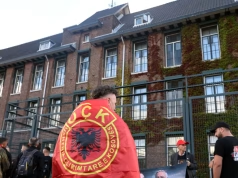
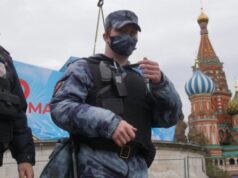
In The Hague, supporters of the accused gathered near the court. Clashes followed the judgment, and Dutch police said two people were detained. Police vehicles and officers were struck with objects, while riot police used force to restore order.
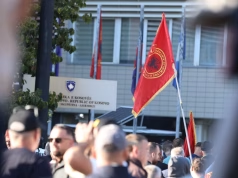
In Pristina, protesters threw stones, bottles and pyrotechnic devices towards the EULEX headquarters and clashed with Kosovo Police. Stones were later thrown near the government building as well. Most public opposition to the judgment was expressed peacefully, but these incidents demonstrated the risk of the legal decision becoming a source of broader political and security tensions.
The demonstrations reflected the deep divide between the court’s legal narrative and the dominant historical memory in Kosovo, where the accused continue to be regarded by many as central figures in the liberation struggle.
The West and its wartime partners
The convictions inevitably raise political questions for Western governments that worked with KLA leaders during and after the war.
Thaçi became a central Western interlocutor at the Rambouillet negotiations and later served as prime minister, foreign minister and president of Kosovo. Veseli, Krasniqi and Selimi also held important political positions after the war.
The judgment does not establish that Western governments knew about, approved or assisted the crimes. Nor were NATO policies or relations with the KLA adjudicated in this case.
Nevertheless, the verdict complicates the historical narrative of Western engagement. A person once treated as an essential partner in building post-war Kosovo has now been convicted at first instance of contributing significantly to a common criminal purpose involving detention, torture and unlawful killing.
That is a political consequence of the judgment, not a separate legal finding.
What the judgment does not say about the Dick Marty report
The case must also be distinguished from the most sensational allegations historically associated with Thaçi.
The 2010 report by Dick Marty for the Parliamentary Assembly of the Council of Europe alleged, among other things, trafficking in human organs taken from prisoners. Those allegations were not part of this trial.
The four accused were not convicted of organ trafficking, organ harvesting or operating a system for the sale of human organs. The judgment concerned unlawful detention, cruel treatment, torture, unlawful killing and crimes against humanity as charged in the indictment.
Conflating the verdict with the Dick Marty allegations would therefore be factually and legally incorrect.
Two conclusions that must be read together
The judgment delivers two major legal conclusions.
First, the court found beyond a reasonable doubt that Thaçi, Krasniqi, Veseli and Selimi made significant contributions to a common criminal purpose through which at least 385 people were unlawfully or arbitrarily detained, at least 303 were tortured, at least 49 were subjected to cruel treatment under the separate charge, and at least 96 were unlawfully killed.
Second, the Prosecution failed to prove that the widespread and systematic attack was directed against a civilian population. For that reason, all four accused were acquitted of crimes against humanity. They were also acquitted in relation to several alleged war-crime incidents.
Neither conclusion cancels out the other.
The acquittals are not a declaration that no crimes occurred. The convictions are not a judicial condemnation of the KLA, Kosovo’s liberation struggle or the right of Kosovo Albanians to resist Serbian repression.
The judgment concerns the criminal responsibility of four individuals. It accepts the occurrence of grave war crimes while rejecting a major part of the Prosecution’s wider legal theory.
Its final meaning will depend not only on the first-instance findings but also on the appeals: whether the defence can overturn or narrow the convictions, whether the Prosecution can revive the crimes-against-humanity charges or post-war incidents, and whether the sentences will survive further judicial scrutiny.
For Kosovo, the judgment is more than a legal document. It confronts national memory, political identity, victims’ rights and the legacy of the liberation war. But precisely because the case carries such emotional and historical weight, its findings must be read with legal precision.
The Hague did not put the KLA or Kosovo’s struggle for independence on trial. It put four individuals on trial—and convicted them of some of the gravest charges while acquitting them of others./Tetova News