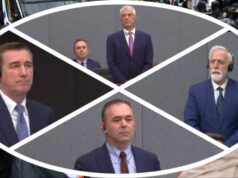

Final statements of the accused at the Specialist Chambers
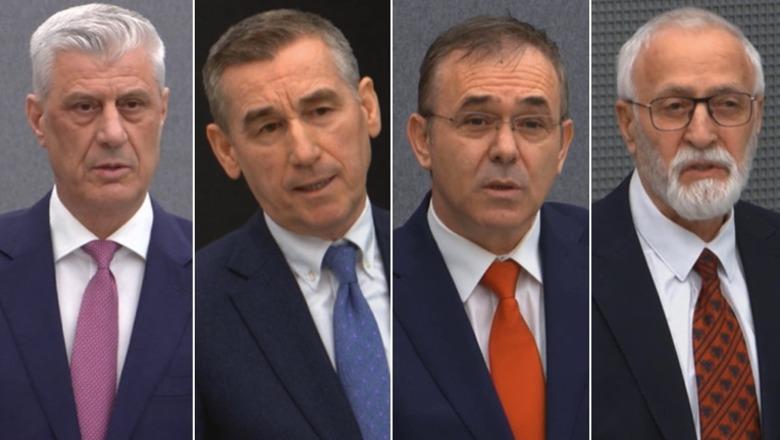
Presiding Judge, Mr. Smith: Their statements, each of the accused has 20 minutes for their speeches. The statements must address only aspects that are relevant to this judicial process. I ask the accused to speak slowly for the sake of interpretation. We will begin with Mr. Thaçi. Mr. Thaçi, the floor is yours.
Final statement of Hashim Thaçi
Honourable Presiding Judge, Mr. Smith, honourable judges, honourable all present, greetings also to all of you following us from the gallery.
Yesterday in Kosovo marked the 18th anniversary of the independence of the Republic of Kosovo. On February 17, 2008, feeling the heartbeats of our ancestors, we declared Kosovo an independent, sovereign and democratic state. I wish from this courtroom today to convey my warmest congratulations to all citizens of the Republic of Kosovo on this magnificent holiday.
Honourable judges, for nearly three years in this courtroom you have heard the prosecution’s accusations and the defense’s arguments. You have seen the facts, you have heard the truth. There is only one truth: that the charges do not stand. I am completely innocent. But I have said it and I say it again, with full conviction: I empathize and express regret for all the victims that Kosovo has had, regardless of their ethnic affiliation.
Honourable judges, at the time of the massacres in Qirez, Likoshan, Prekaz, in early 1998, I was a student at the University of Zurich. I was not making plans on how to take control in Kosovo, I was making plans on how to prepare for my university exams. The only one making morbid plans was Slobodan Milošević – plans for another genocide, for a new xenocide in Kosovo.
Like many other Kosovar citizens, I too was earlier forced to leave Kosovo, because Milošević’s regime had persecuted me. He had sentenced me in absentia on charges of violating his discriminatory laws. Later, the same regime would sentence in absentia President Clinton, Secretary Albright, Prime Minister Blair, Chancellor Schröder, President Chirac, NATO Secretary General Mr. Solana and others – sentences in absentia.
Therefore, seeing the massacres against my people, I, like others, could not remain indifferent. I decided to return to Kosovo in the spring of 1998. This was entirely my personal decision, no one else’s, because I could not stand by while my family and my people faced extermination. I did what any of you would do, if your country, your people, were experiencing what my people experienced. I am very proud of this and I never regret it.
Honourable judges, the prosecution claims that the goal was to take and exercise control in Kosovo. This is not only completely untrue, utterly absurd, but it is also deeply offensive. It is an insult to the memory of thousands of heroes who gave their lives for freedom. It is an insult to the tens of thousands of innocent victims killed during the massacres. It is an insult and an injustice also to the efforts of NATO and the Western alliance, with which I cooperated closely.
Allow me to repeat an eternal truth: my only, my only opponent, that of the people of Kosovo and the democratic world, was Slobodan Milošević. It is hard to hear this accusation. The fact that some of us are alive today is entirely chance and luck. I did not return to risk my life for control and power; I returned to my homeland, risking my life, for freedom and peace.
The question raised today is: taking control from whom? The truth is that control and power were completely, throughout the entire territory of Kosovo, in the iron hands of Slobodan Milošević. Albanians did not exercise power; they were oppressed by Milošević’s power. Our mission as a people was clear: survival, freedom and peace. I had no illusions, but our only hope for salvation was the democratic world, the United States of America and NATO. Therefore, my entire focus was on building and strengthening this alliance. For this purpose, I traveled to many capitals – Brussels, London, Berlin, Paris, Bern, Oslo, Vienna – to convince them of our just cause, but wherever I was, I was in constant contact with officials of the American administration.
Milošević had started the war in Kosovo, while we Kosovars were only defending ourselves. But only NATO could end the war, no one else, and that’s what happened. Had it not been for NATO’s intervention, there would be no freedom for Kosovo, no independence either. Therefore, independence was not an instrument to seize power, but for dignity.
Honourable judges, this prosecution has woven many praises for me and bestowed many titles and ranks upon me, but the truth is quite different. I was not the one who transferred the resistance from the West to Kosovo; I joined the resistance in Kosovo. It was not my return from the West that was the reason for the KLA’s massive growth – the reason was Slobodan Milošević. No one said it better than Secretary of State Madeleine Albright, I quote: “Milošević, with his behavior towards the people of Kosovo, is the greatest recruiter of the Kosovo Liberation Army.”
The KLA was not a state, not the army of a state. It was a popular organization defending itself against an aggressive state. The fact that the KLA was not organized as the prosecution claims, does not diminish its role for Kosovo’s freedom, does not make its liberation cause any less noble, nor the achievement of independence any less historic. Kosovo’s victory was more political and diplomatic. The greatest success of the people of Kosovo was full cooperation and trust in the West. They helped us precisely because they knew who we were and what our goal was. I, at any cost, under no circumstances, would risk this alliance, because that would risk the very freedom of Kosovo, would risk our collective existence.
Our goal was peace, not war. When the democratic world decided to call the Rambouillet Peace Conference, we responded positively to their invitation. The Kosovo Liberation Army was one of the three representative groups of Kosovo at this conference. However, throughout the process in Rambouillet and Paris, we worked as a delegation of Kosovo. We accepted the Peace Agreement, even though it did not meet all our legitimate demands. Kosovo chose peace and democracy; Serbia chose war and genocide.
To help the international community, as requested by the Westerners, the three groups – the Democratic League of Kosovo, the KLA and the LBD – agreed on the formation of a joint government that would function until the first free and democratic elections in Kosovo. It was an agreement to unite forces and energies for a common goal: Kosovo’s freedom. Today, how can anyone claim that the goal was to take control of Kosovo, when we accepted that the international community would have the primary say in Kosovo, and then that the KLA would hand over its weapons to NATO, as happened later in June-September 1999?
After Milošević’s capitulation, Kosovo was placed under the administration of the United Nations – a globally known fact. UNMIK made it clear from the beginning that all executive, legislative and judicial power was in their hands. These were completely different circumstances. Afterwards, I worked with UNMIK and other political parties to help implement the mandate in the best interest of the people of Kosovo. I worked with the joint structures of UNMIK. Honourable judges, throughout all this time, the only power I had was the power of my voice.
And, honourable judges, as you have seen during the judicial process, I used my voice to promote a multi-ethnic and tolerant society in my country, in Kosovo. It was the fairest and most proper thing I could do. When graves were being opened everywhere in Kosovo for thousands of victims, thousands of missing persons were not found, thousands of Albanian hostages were taken to Serbia – the pain was deep and collective. What I could do, what I was doing, could have physical and electoral consequences. But Kosovo was more important than my personal fate.
After NATO’s entry into Kosovo and the withdrawal of Serbian forces, the citizens of Kosovo were not fighting; they were celebrating long-awaited freedom. During the first nine years, 1999-2008, I called on the population to be patient, to be tolerant, united, and to have faith in our international partners. Independence was the fruit of our alliance with the democratic world. After independence, we worked with the European Union, the USA and other relevant factors to normalize relations with Serbia.
Honourable judges, what we faced was not just the war period; it was a century of oppression and apartheid. Collective trauma also caused strong feelings of anger and revenge during and after the war. President Clinton came to Kosovo immediately after the war and told us: “We won the war, while you must win the peace.” I took this message very seriously. I used my voice to call for peace, tolerance and unity. For most of the post-war period, until the declaration of independence, I was not in power; I was out of power. Even when I came to power through electoral victory, I always respected democratic norms and election results. Whenever my party was in power, it was always in coalition with the Democratic League of Kosovo and other Albanian and non-Albanian political parties. Together we made the state of Kosovo a reality.
But, honourable judges, Russian and Serbian propaganda would not stop easily. After failing to delegitimize Kosovo’s independence at the International Court of Justice here in The Hague, they turned to the Council of Europe. They revived the terrible allegations of organ trafficking – allegations that had been investigated before by The Hague Tribunal, UNMIK and EULEX and were dismissed as unfounded. As soon as the Dick Marty report was published, as Prime Minister of Kosovo at the time, I convened the main international representatives, the Quint ambassadors in Kosovo and EULEX leaders. I requested another independent investigation. They promised. Dick Marty fell victim to their campaign; they fed him false information and eventually even tried to kill him to blame us. The goal was very clear: to discredit the most successful international political and military project in recent decades – Kosovo’s success story.
When we voted in the Kosovo Parliament to establish this court, we believed it would address the allegations of the Dick Marty report and act in accordance with the Constitution and laws of the Republic of Kosovo. In practice, neither happened. I have been and still am heavily criticized in Kosovo for supporting the establishment of this court. Critics say this court aims to criminalize our war for freedom and the idea of independence. I did not believe this at the time we voted for it, but I sincerely hope that time will prove me right and the critics wrong. This prosecution, instead of removing the dark cloud over Kosovo, seeks to obscure the sun with a black storm. The so-called “joint criminal enterprise” – many of the accusations I have heard from this prosecution, honourable judges, in this courtroom, I have also heard during election campaigns in Kosovo, they are the same.
It is a painful truth that this prosecution tries to dismiss the testimonies of high-ranking NATO officials, of the United States of America, of Great Britain and the UN in this court – of those people who were with us in the field the whole time, who were the eyes and ears of the West in Kosovo. Worse, this prosecution claims that I misled them throughout the war. This is utterly ridiculous. Apparently, this prosecution overestimates me more than I deserve. On the other hand, this prosecution exalts to the skies testimonies fabricated during the era of Slobodan Milošević’s regime. Thus, it ignores the truth itself.
Honourable judges, at the very end…
Presiding Judge, Mr. Smith: Mr. Thaçi, you have exceeded the allotted time.
Hashim Thaçi: …in Rambouillet, I supported the request for the Tribunal for the former Yugoslavia to investigate the alleged crimes of all parties. From the end of the war, all competencies for investigating war crimes were in the hands of the Tribunal for the former Yugoslavia, UNMIK and EULEX; I supported their work. No accused for war crimes in Kosovo had escaped, and no stone was left unturned to oppose legal processes during the 25 post-war years. After the declaration of independence, when I was Prime Minister of Kosovo, I agreed that independent war crimes investigations remain in the hands of EULEX. As President of Kosovo, I engaged eminent international and local experts from all communities to create a transitional justice forum for victims – the Truth and Reconciliation Commission. But the truth is that justice for victims cannot be built by prosecuting the innocent; reconciliation cannot happen with selective and ethnic prosecutions.
Honourable judges, final sentence: Throughout my life, I stood by the people of Kosovo in defense of freedom, life and human dignity, always guided by Western ideals of democracy, equality and justice. Today, at the conclusion of this process, I have only one plea: honourable judges, that your decision be in accordance with the Constitution of Kosovo, the laws, the evidence and the facts. The evidence presented makes it very clear that the charges do not stand. Therefore, the only just decision is full acquittal. Thank you very much.
Presiding Judge, Mr. Smith: Thank you, Mr. Thaçi. Mr. Veseli, the floor is for you now.
Final statement of Kadri Veseli
Greetings. (Apologizes) It was my mistake, I apologize. Once again, greetings to all present in the courtroom, greetings to all the guests who are in the waiting room, thank you very much. Greetings to all citizens of the Republic of Kosovo.
Honourable Presiding Judge, honourable members of the panel, at the end of my trial I address you to emphasize a single point, but of extraordinary importance: The Court must, at all costs, protect justice, truth and impartiality. This is not merely a legal duty; it is its greatest contribution and the legacy that will remain of this court.
This is also the reason why I joined those thousands of women and men who lined up in the ranks of the Kosovo Liberation Army for the freedom of Kosovo. And why I have served my entire life for my country, so that every citizen enjoys justice and the world knows the truth about our nation. Even in the darkest moments, I never lost faith that right, truth and freedom would triumph. I have always believed that the people of Kosovo, like any other people in the world, had the inalienable right to live in freedom and dignity. I believed that the suffering would end and that justice would come, even if late.
At the same time, I have never believed that violence, hatred or revenge could be honest guides. They destroy the soul of a people, not just the victim’s. Hatred is just another form of slavery. Freedom cannot be achieved through injustice, nor can peace be built on crime. A just cause cannot be defended by unjust means. This has not been just a theoretical principle for me, but a deep moral conviction that has guided each of my actions.
My family and I have lived under constant persecution by the Serbian state. This is not an abstract description; it is a concrete reality that has affected every member of my family, but also all of my people. Men, women, children, without exception, faced injustice, fear and insecurity every day. I know what it means to be unprotected; I know what it means to live under constant threat. This is an experience I wish on no one, but it also taught me an essential truth: in injustice, one must preserve moral integrity and fundamental human values.
Some may ask: are these just words, or have they been reflected in my life and actions? My answer today is clear: not only in my words, but above all in the evidence presented before this court. After decades of investigations, countless documents and testimonies, there is no evidence to show that I committed any crime. No illegal act on my part has been proven. This is not a matter of interpretation; this is a matter of fact.
Regarding my participation in the war, it was not born from my desire for conflict. I have always desired a simple life, to live in my country with dignity, in peace with my family. I was a student when Kosovo’s autonomy was abolished and the university was attacked by Serbian forces. I participated in peaceful activities to protect our fundamental rights. But all these rights were denied to us. Kosovo’s autonomy was removed; we students were expelled from dormitories and faculties; our professors were all expelled; our people were deprived of the most elementary opportunities to live as free and equal citizens.
The truth of what was happening is now publicly known: Serbia and Slobodan Milošević sought control over all the peoples of Yugoslavia. This tendency then led to the era of wars and hatred in the former Yugoslavia, which led to its own destruction. In early 1990, I left Kosovo. It was a forced departure, but also an opportunity for a more normal life, for a future built on knowledge and progress. But, while I lived in a free country, my country was experiencing deep suffering in captivity. The situation in Kosovo turned into denial and exclusion of the majority. After the Dayton Agreement, Albanians in Kosovo as a majority were left completely excluded; they could not live freely, but only survived under threat, intimidation and repression.
In early 1998, I was at the University of Fribourg in Switzerland, when the Likoshan massacre occurred. It was a grave tragedy and atrocity that should never have happened in Kosovo. The tragedy in Prekaz on March 5-6, 1998, was not an isolated act, but a continuation of massacres committed by Serbian forces. Such acts of terror exceeded the normal fear of ordinary people and the caution of intellectuals and politicians in Kosovo. Terror and massacres like those in Srebrenica had begun to happen in my country too. In Kosovo, I could not remain indifferent, while my people faced destruction. For me, life had meaning only if my people could live in freedom. Therefore, I returned to Kosovo – not as a trained soldier, but as an individual still studying. I returned not with hatred, but with conviction. I returned because I felt a moral duty to my country. I returned because I could not remain indifferent to the suffering of my people. My goal was clear: to contribute to the freedom and justice of my people, but not to do injustice to anyone.
I have seen in recent months in this courtroom how easily some underestimate the difficulty of stopping a conflict and building peace. But history teaches us that those who establish peace often face consequences. Looking at today’s reality, when the world so needs peace, it is clear that it is not always easily achieved and preserving it is often even more difficult.
Honourable panel, the creation of this court and its functioning to date is the result of a broad debate in my country. But above all, what must prevail from it is justice and impartiality in judging the truth and the objective reality in which we acted. I stand in this process with conviction and faith that truth has no reason to fear justice and that justice may be delayed, but it is never denied.
I have acted with this conviction, I have lived with this conviction. Today, here before you, I stand with this conviction and can confidently say: I know who I am. I know what I have done and what I have not done. My actions have been human and lawful. My conscience is clear; my history is transparent. Now, everyone can see it also in this judicial process.
Concluding my speech, honourable panel, with respect for everyone in this room, and outside it, even if we may disagree, I want to emphasize: we are all human beings, with inclinations and thoughts influenced by those around us and the environment we live in. My faith in truth and justice remains unwavering and I firmly want to believe that in your decision only truth, impartiality, justice and the law will prevail.
Honourable panel, since yesterday was the independence day of my country, I have only one greeting at the end for all citizens of my country: Happy Independence! Enjoy, citizens of the Republic of Kosovo, your freedom! May God bless Kosovo and its good people!
Finally, I wish to extend a special greeting to the family of a friend of mine and defender, who is not here today. At the same time, I want to thank my defense team for their professionalism and sincerity in my defense. Thank you all!
Presiding Judge, Mr. Smith: Thank you, Mr. Veseli. Mr. Selimi, the floor is for you.
Final statement of Rexhep Selimi
Honourable panel, honourable President, honourable attendees, allow me to greet my family and friends up in the gallery, as well as all citizens of the Republic of Kosovo.
This is the third time, and I hope it will be the last, that I take the floor in this courtroom. More than five years have passed since the beginning of this judicial process. These five years have not been easy for us, nor insignificant for the history of my country. However, let all this serve as an opportunity and a good chance for justice. After all these years, there is one positive element: I hope that the panel has had enough time to understand that our war was just and that the prosecution’s claims are unfounded.
In my speech in this courtroom in April 2023, when this process had just begun, I said I was facing an unfounded indictment. Today, after this entire journey, the course of the process has proven me right. The charges against us are completely baseless and unjust.
I have not risen here today to defend myself, because my lawyers know this best and have done that. I am not here to tell you about justice, because you know it better than anyone. I am here today to ask you precisely to exercise that justice.
Although nearly three years have passed since the start of this process, the prosecution has continued to rely on claims that have no basis in truth and in a persistent attempt to tarnish a war that was essentially liberating. Although the prosecution, at the beginning of its closing statement, declared that it does not seek the conviction of the KLA General Staff, throughout the time it had at its disposal, its target was precisely the KLA General Staff, the Kosovo Liberation Army, and particularly its goal, which was Kosovo’s independence. It even created the impression that independence itself was being treated as a common criminal goal.
In an attempt to hold the KLA General Staff responsible, the prosecution took accusatory positions such as, I quote: “The General Staff sought independence,” or further, “The General Staff declared that it would not support autonomy.” It is difficult to understand against whom this indictment is really raised: against us for concrete actions, or against us because we fought for Kosovo’s independence? This remains to be assessed by you, honourable panel.
Equally problematic is the prosecution’s attempt to divide Kosovar society in two – into those who were for independence and those who were for autonomy – as if wanting at all costs to create division among the citizens of the Republic of Kosovo. To illustrate this, I paraphrase what the prosecution stated during the presentation of evidence last week: “The General Staff sought Kosovo’s independence; political parties that supported autonomy were considered traitors.” Honourable, in Kosovo there has never been any Albanian political party that was against independence, and consequently none that supported any autonomy within Serbia. All Albanian political parties were for independence, as was the very goal of the Kosovo Liberation Army. To present support for independence as a radical demand and autonomy as “modern” is an attack not only on Kosovo’s history, but also on its future.
As if the prosecution tries to divide us Albanians among ourselves and equate the KLA with Serbia’s crimes. No one can do either. A liberation war cannot be equated with Serbia’s murderous state. To equate the resistance of an oppressed people with a criminal plan means to place the resistance of the oppressed on the same level as the oppressor’s project. This equation is not only incorrect, but deeply unjust.
To deliberately attempt to alter historical facts through accusations with distorted claims is simply to try to rewrite history. But Kosovo’s history cannot be rewritten, especially not in a courtroom. Kosovo’s history was written at the cost of sacrifice by its citizens, freedom fighters and martyrs of the homeland.
When Serbia and Milošević were killing my peers, poisoning pupils and students, removing our parents from work, closing schools and hospitals, persecuting us to kill us and carrying out ethnic cleansing and genocide – what were we supposed to do? Not react? Serbia never hid its goal towards Albanians. In this courtroom, we heard the testimony of General Clark, who during a meeting he had with the Butcher of the Balkans heard his open intentions towards Albanians. We and all the public following that testimony heard the NATO general say, I quote: “Milošević told me that we know how to deal with Albanians – all must be killed. And we knew this, because Serbia never hid its goal towards Albanians.” So I ask again: what were we supposed to do? Wait our turn to be killed, or flee our country and homes? Neither. Therefore, we had to resist. Therefore, I believed that Kosovo needed self-defense, needed people willing to give even their lives for their country, needed someone like Adem Jashari and the Kosovo Liberation Army. That’s why I joined Adem Jashari.
The Kosovo Liberation Army was not created by desire, but by necessity. It was a reaction to systematic violence and denial of dignity. It was not an adventure, it was survival. Honourable, I was part of a volunteer army – 100% volunteer – composed of civilians, teachers, students, farmers, workers, parents; people forced to take up arms because they had no other way.
In one part of its submissions, the prosecution, strangely and in the form of an accusation, describes me as a man “close to Adem Jashari” and as an “organizer who enjoyed respect”. It is unclear whether this is meant as an accusation or as praise. For me, being a comrade-in-arms of Adem Jashari is the greatest honor I could have. Likewise, I consider it an honor to be described as one of the main founders of the KLA. If these descriptions turn into accusations, then the problem is not with me, but with those who treat honor and historical responsibility as guilt.
Yes, I bore arms. Arms were for survival. Many of my comrades-in-arms died securing them. We sought help and weapons even from friendly countries, including the United States of America, which has also been addressed in this courtroom. The KLA had no goal other than freedom. It had no plans to attack civilians or political opponents. The Kosovo Liberation Army was not a political party, it was a liberation army.
Even if the war in Kosovo had not stopped in June 1999 and continued to this day, I would still be a soldier of my homeland – of course, if I had not been killed by now, for which the chances were real. I am convinced we did the right thing. I would do the same today. Freedom, peace and democracy are achieved by confronting aggression. That’s why NATO supported us, that’s why your countries supported us.
The prosecution, in its final brief, seeks extremely severe sentences, so long that they essentially aim to permanently prevent our return to our country. Whether I will return to Kosovo from now on depends on your decision. But the prosecution should have understood that, whenever I return, I will return to a free Kosovo, to the Kosovo I am proud of, that I stood up for at the right time and for whose freedom I have been and remain ready to give my life, if ever asked of me.
With respect for each of you in this room, I believe that if your countries were in the same circumstances as Kosovo experienced, you would act the same. I am convinced that you too would fight for your people and your countries, just as your ancestors did before your countries became free and democratic.
Many things happen during war. There is chaos, fear, individual actions and pain accumulated from years of oppression. War always leaves consequences and victims. Precisely these victims need justice based on truth, because justice that is not based on truth hurts the victims for a second time and destroys its very purpose.
After all that we heard from the parties over these years, my request is simple: that the decision be based only on what has been proven, not on what has been suggested; on facts, not on conjecture; on laws, not on impressions. I am confident that justice, and only justice, will return us to our homeland, us who are here accused.
Finally, I wish to thank our defense teams, and especially my team led by Jeffrey Roberts, for their professional commitment in my defense, in defense of the right and, above all, in defense of our just war. But above all, I thank our fellow citizens who believe in our innocence. Their support has made the shackles that have weighed me down feel not like a burden, especially when those shackles no longer weigh on Kosovo, as they weighed throughout the time it was under Serbia’s brutal occupation.
It is said that people who do something good for their homeland are lucky people. It seems I am one of them. Thank you.
Presiding Judge, Mr. Smith: Thank you, Mr. Selimi. Mr. Krasniqi, the floor is now for you.
Final statement of Jakup Krasniqi
Honourable President of the trial, honourable judges, and through you I also greet all the citizens of Kosovo who celebrated their independence, citizens who live in freedom, in independence and with justice.
I stand here before you today, honourable citizens, not as a criminal described by the prosecution’s indictment, but as a man born and tempered in struggles for human dignity, from a people who refused to disappear under the politics of crime and genocide of Serbia.
Most of my life I have spent guided by the belief that human beings deserve to live in freedom. After more than five years of unjust and, in my opinion, unnecessary imprisonment, I have been engaged early on to give a true account of our war for independence against the policies of persecution and genocide of the Serbian regime, which brought unprecedented suffering and destruction to the people of Kosovo.
For more than five years, I believe my human rights, guaranteed by the European Convention on Human Rights and fundamental freedoms, have been denied. Among them, the most important is the right to live in freedom, especially the right of a person in the final stage of his life to live his remaining years with dignity, close to his family and in his free homeland. This has been done to me without causing injustice to anyone, without endangering the life of any single person. On the contrary, I have risked my life, not only during the liberation war, but since the years 1972-73, together with my family, with my compatriots, with my fellow villagers, in the belief that the darkness of injustice would be broken by the dawn of hope. This is the reason why I engaged for liberation and equality for all.
I particularly emphasize the period after June 11, 1998, when I came out openly with my full name and unmasked as the KLA spokesman. The risks were extraordinary, but I did not worry about my safety, because I was guided by my commitment to all citizens of Kosovo and their future.
Today I am in my 16th year of imprisonment, only because I fought for the freedom and independence of my people. I said the 16th year, because I spent 10 years or more in prison from 1981 to 1991. To have spent 16 out of 75 years of life in prison and to be deprived of the air of freedom is not a small thing; it is a great thing.
My public appearance on June 11, 1998, showed that I was an opponent of Serbia’s genocidal policies and happened shortly after the Serbian massacres in Qirez, Likoshan and Prekaz, where 83 people lost their lives, most of them children, women and the elderly, unarmed, killed in their homes. These brutal killings marked a turning point in the consciousness of an entire generation of Albanians.
What drove me to take this extraordinarily risky act at that time? The long enslavement, persecutions, beatings, rapes, numerous imprisonments and incessant executions that marked the entire 20th century. These cruel acts did not break me, on the contrary, they made me determined that justice should not be broken on the back of the tyranny we experienced. Love for life and freedom made me take this role. A person does not choose resistance easily; he chooses it when every other door to dignity is closed.
The most human right of every person born free and of every reasonable person who knows the value of human dignity and equality of all was denied and forbidden to me: the right to openly love my country, to work for it and to pass on what I have learned through decades of life and sacrifice. But for these virtues, I was handcuffed on November 4, 2020.
The prosecution’s accusations against us and the KLA are built on the narratives of those who caused several wars throughout the Yugoslav federation within a single decade. I do not believe that this indictment serves any justice, especially not the justice that democratic societies claim to achieve. Justice cannot be built on the language of former oppressors; it must stand on reliable evidence and on truth.
The injustice of this case is written in the indictment itself. I am charged with roles of authority and responsibilities I never had. This was not a matter of difference in interpreting facts; it was slander. The figure described in the prosecution’s document is not the man standing before you today. I am grateful to those witnesses who came here and had the courage to tell the truth about who I was and who I was not. They did not come to defend me, but to defend the facts, our historical reality of Kosovo. Their testimonies confirmed a simple reality: I did not possess the power, command or functions attributed to me in this case.
When the truth is told simply, it needs no embellishment. The whole world knows that NATO intervened against the crimes committed against Albanians in Kosovo. NATO and the democratic world have never aligned themselves with terrorism or genocide. Without that intervention and international support, our freedom would not exist. But without our noble resistance, it would never have been achieved.
The action of the KLA and my actions, both during and after the war, always prioritized peace, and this has been proven. Credible voices have testified to this. We stand here today unjustly, but history will understand why we acted.
It is not enough just that we are accused; I must speak about the historical reality that surrounds this case. The crimes and persecutions by Serbian forces that shaped that period are inseparable from the actions you are asked to judge. They are not background noise; they are written in public history in letters too large to erase. They remain part of the reality you are asked to judge. I join my lawyers in asking you, honourable judges, to keep that history firmly in mind, because judgment without context risks confusing the consequence with the cause. Please, do not make that mistake.
Our war was not unique in history. Every nation that has sought freedom from an illegal occupation, similar to apartheid, has faced accusations that resistance is criminal. However, international law affirms that peoples facing systematic persecution are not enemies of justice; they are acting in accordance precisely with the principles on which justice stands.
Our generation had a vision: life in freedom, equality, democracy, the rule of law. It was this vision that guided the war, which culminated in the declaration of Kosovo’s independence on February 17, 2008.
Honourable judges, our people have never sought the destruction of another nation, ethnicity or religion. We fought only for life, freedom, democracy, equality and justice – not to control territory for domination, out of greed or criminal gain. Our goal was to return Kosovo to its people, to all its people, so they could live with dignity, security and equal rights. Any accusation that says the opposite is a continuation of the lies produced by the criminal regime of Serbia.
For all my political activity, honourable judges, I am truly proud. My voice stood for freedom. I did what I believed human nobility demanded. No witness has said otherwise. I ask you to look at the evidence and testimonies objectively, and there you will find the truth. Justice is not afraid of scrutiny; it depends on it.
Honourable judges, I repeat respectfully once again: our people never planned destruction or torture. We sought life in freedom and independence – nothing more, nothing less. Today, our people live in freedom. If love for freedom is judged as a crime, then history itself will be condemned.
I stand before you as I have stood all my life: responsible to the truth and unafraid of it. I dedicated my life to the belief that people deserve freedom. If this belief is judged as a crime, then history itself will have its day, long after this court has spoken.
I ask you to judge each piece of evidence patiently and without prejudice, and you will not find a criminal enterprise, but a human story shaped by hope and necessity, by faith in victory and democracy. If this belief in our freedom is judged justly here, then justice will not only serve me, but will honor the principle that created this court.
I end my speech here, seeking justice, which is clearly seen. Thank you for your attention.
Presiding Judge, Mr. Smith: Thank you, Mr. Krasniqi.
Before I close the judicial matter, I wish to ask the parties and participants if they wish to raise any final matters of their own.
SPO, Mr. Holling? No, we have no matters.
Mr. Smith? Victims’ Counsel? No.
Mr. Misetic? No.
Mr. Dixon? No.
Mr. Roberts? No.
Ms. Gendra? No, we have no other matters.
Before concluding this judicial matter, I wish to remind participants and parties that, in accordance with rule 136, they cannot make further submissions to the panel at this stage, except in exceptional circumstances and if requests are justified. Certainly, this does not concern matters that need to be reviewed regularly, such as pre-trial detention.
The panel wishes to thank all defense teams and all persons who have assisted in the successful completion of this judicial matter. We have felt very assisted by your contributions to ensure the fairness of the process. Both the defense teams and the accused have received effective services throughout. We also wish to thank the Court Management Unit for their excellent work and support throughout this judicial process. Also, we are very grateful to the stenographers, interpreters and all the staff of the Administrative Office for their continuous support.
We will continue to be in constant contact, as needed, with the parties regarding the date of the pronouncement and publication of the judgment. In accordance with rule 136, paragraph 1, this judicial matter is closed here. The hearing is concluded. Clerk, all rise.
This response is AI-generated, for reference only.