
The shallow earthquake struck southwestern Japan at 4:27 p.m. on July 28; around 80 minutes later, an explosion destroyed part of Aeon Mall Kumamoto. An LPG leak is considered the leading theory, but the cause, ignition source, and performance of the safety systems remain under investigation.
Updated July 29, 2026, at around 10:00 p.m. Japan time
A magnitude 7.1 earthquake that struck Kumamoto Prefecture on the southwestern Japanese island of Kyushu on the afternoon of July 28 has killed at least 18 people and injured 62 others, six of them seriously. It caused building collapses, fires, extensive damage to roads, bridges and railway lines, as well as widespread power and water outages.
The disaster took an even more serious turn around 80 minutes after the main shock, when a powerful explosion tore through Aeon Mall Kumamoto, one of the largest shopping centres in the prefecture, located in the town of Kashima. The blast ripped away sections of the exterior walls and roof, twisted parts of the steel frame, brought down ceilings and hurled debris hundreds of metres from the building.
According to the latest update, four deaths had been confirmed at the shopping centre, while three employees remained unaccounted for. At Nippon Paper Industries’ Yatsushiro mill, where a large industrial chimney collapsed, five people were killed and four others were believed to remain trapped beneath the rubble.
Search-and-rescue operations are continuing under difficult conditions because of frequent aftershocks, the danger of further structural collapses, temperatures above 35 degrees Celsius and concerns about a possible gas leak around Aeon Mall.
The 4:27 p.m. earthquake
The earthquake struck at 4:27 p.m. local time on July 28. The Japan Meteorological Agency measured its magnitude at 7.1 and placed the focus at a depth of 16 kilometres, classifying it as a shallow inland earthquake.
The maximum seismic intensity of 7, the highest level on Japan’s seismic intensity scale, was recorded in the city of Uki and the town of Hikawa. An upper 6 intensity was measured in Kumamoto City’s Minami Ward, as well as in Yatsushiro, Uto, Misato and Mashiki.
The shaking was felt across a wide area, from parts of central Japan to Kyushu. A tsunami advisory was briefly issued for the Ariake and Yatsushiro seas before being lifted.
Because of its magnitude, intensity and inland location, the Japan Meteorological Agency officially named the sequence the “2026 Kumamoto Earthquake.”
Within minutes, reports emerged of collapsed buildings, fires, fractured roads, fallen utility poles, damaged bridges and people trapped under debris. Kumamoto Prefecture activated its disaster response headquarters at 4:27 p.m., requested the deployment of national emergency fire units and began coordinating operations with Japan’s Self-Defense Forces.
Panic and clouds of dust inside Aeon Mall
Aeon Mall Kumamoto is located about eight kilometres southeast of central Kumamoto City. The two-storey complex covers approximately 120,000 square metres and housed around 200 shops, restaurants, a cinema and other businesses.
The mall had reopened only a month earlier following a major redevelopment intended to mark its recovery from the devastating 2016 Kumamoto earthquake. The redevelopment had highlighted seismically reinforced ceilings and broader improvements to the building’s safety and resilience.
When the July 28 earthquake struck, witnesses said the building shook violently for around ten seconds. One employee said the movement forced him to his knees, while a 22-year-old cinema worker described a cloud of dust rising inside the complex and making it difficult to see and find the way out.
In footage recorded during the earthquake, people can be heard reassuring one another, while others warn about the large amount of dust. Shoppers began moving rapidly toward the exits and parking areas.
A family who had been inside said they had just finished eating ice cream and were taking photographs when the shaking began:
“We crouched down on the floor and held each other tightly.”
According to Aeon President Akio Yoshida, staff evacuated around 3,000 customers within half an hour. The company initially believed that employees had also left the building, but it later emerged that some people had either remained inside or returned.
Why they stayed or went back into the building has not yet been determined.
At around 5:50 p.m., a devastating explosion
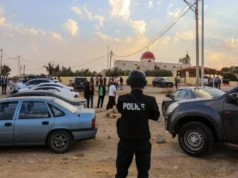
At approximately 5:50 p.m., around one hour and 20 minutes after the earthquake, a powerful explosion struck the south-central section of the complex. The first emergency calls were received at around 6:00 p.m.
The blast tore away a large part of the façade, exposed the building’s steel beams and caused sections of the second floor to collapse. Entire ceilings fell inside shops, storefronts were blown open and furniture was scattered across the floor.
Footage later recorded by police showed daylight streaming into the building through areas where the exterior walls and roof had been destroyed.
In the parking lot, people were engulfed by smoke and dust so dense that visibility was significantly reduced. Sections of the façade landed on power lines, roads and nearby farmland.
A large piece of the exterior wall struck the cargo area of a truck on a nearby road, creating a large hole in the vehicle. The driver reportedly suffered minor injuries.
A resident who was about 700 metres away said the impact was so strong that he briefly thought his house had tilted. Although there was no wind, he felt a powerful pressure wave that he described as being like a blast wave.
Takateru Sonoda, 41, who operates a combined hair salon and café near the mall, said he initially thought a bomb had exploded. Sirens were sounding, people were shouting for others to evacuate and nearby roads became gridlocked.
About 300 metres away, Kazuya Tsurunaga was clearing up plates and glasses broken by the earlier earthquake when he heard the deafening explosion. The cloud of smoke and dust moved toward his pub and, according to his description, it looked as though volcanic ash was falling around them.
Why were people still inside?
Aeon executives said the evacuation of customers had been completed and that they initially believed all employees had also left the building.
It later became clear that some people had remained inside or returned. One survivor was found injured in a restroom.
It has not been established whether they returned to inspect shops, retrieve personal belongings, check damage or for some other reason. The company has said it does not want to speculate before the facts are confirmed.
This is one of the central questions investigators must answer: whether there was a clear prohibition on re-entering the building after the earthquake and how employee access to potentially damaged areas was managed.
The casualty figures changed throughout the day
The reported numbers of deaths and injuries changed as rescue operations continued and the condition of people recovered from the rubble was medically confirmed.
At 2:00 p.m. on July 29, Kumamoto Prefecture’s detailed official count included:
- 12 confirmed deaths;
- six people in cardiopulmonary arrest;
- eight seriously injured;
- 80 people dead or injured in total.
At the same time, the central government was reporting 13 deaths, including cases whose direct connection to the disaster was still being investigated.
The death toll later rose to at least 18, with 62 people injured, six of them seriously. The earlier figures of 12 and 13 were not necessarily contradictory; they reflected different stages of identification and medical confirmation.
At Aeon Mall, afternoon reports initially listed three confirmed deaths, one person in cardiopulmonary arrest and three employees missing. A later update raised the number of confirmed deaths at the mall to four, while three people remained unaccounted for.
A complete and final location-by-location breakdown of all 18 deaths had not yet been released when this article was prepared.
Search operations delayed by collapse and gas risks
During the first hours after the explosion, police officers and firefighters could not immediately enter all sections of the wreckage. The building remained unstable, aftershocks were continuing and there were fears of a gas leak and another explosion.
The operation continued throughout the night with firefighters, police officers, soldiers, medical teams and trained search-and-rescue dogs.
The Self-Defense Forces deployed around 170 personnel specifically to Aeon Mall. In the wider prefectural operation, the number of military personnel was increased from around 3,600 to 4,600.
Eight people were recovered from the shopping centre during the first hours. The number later increased, while the classification of their condition changed following medical examinations.
All 25 cats left behind in a cat café during the emergency evacuation were rescued alive.
Main theory: an LPG leak
Investigators have not yet announced a definitive cause of the explosion. However, witness accounts and initial evidence have placed a gas leak at the centre of the investigation.
Several rescuers reported smelling gas inside the building. Emergency vehicles repeatedly warned people not to approach the site.
Aeon Mall Kumamoto was not supplied by the municipal gas network. It used LPG — liquefied petroleum gas — stored in an outdoor tank and pumped into the building through internal piping.
The external storage tank appeared intact after the explosion. The system had undergone a safety inspection only the previous month, before the mall reopened.
Aeon President Akio Yoshida said the likelihood that gas had caused the explosion was “very high,” but stressed that a full investigation was needed to establish exactly what had failed.
Under safety regulations, both municipal gas systems and LPG installations should have mechanisms that cut off the supply during major shaking, leaks, abnormal pressure changes or pipeline damage.
Microcomputer-controlled meters are designed to stop the gas automatically during strong seismic activity. Suppliers and safety service providers can also shut off the supply remotely.
Investigators must determine:
- whether the emergency shut-off system activated;
- whether gas continued to escape after the supply was cut;
- whether a pipe downstream of the safety valve was damaged;
- where the gas accumulated;
- how long the leak continued;
- what ignited it.
Damaged pipes, loosened valves or an electrical spark?
Safety-engineering specialists warn that an explosion of this kind would usually require a chain of failures rather than a single defect.
One possible scenario is that the initial earthquake damaged pipelines or connection points, while aftershocks and collapsing structural elements placed repeated stress on the installation. Valves may have loosened or pipes may have fractured in an area that was not fully isolated by the automatic system.
If gas accumulated in an enclosed space, ignition could have come from a spark caused by damaged electrical wiring, the activation of an electrical device, a light switch, motor, ventilation system or another energy source.
These remain technical hypotheses, not conclusions of the investigation.
Aeon has decided to conduct emergency inspections of gas systems at all of its shopping malls across Japan. National authorities have also asked gas operators in affected areas to carry out immediate safety checks.
Experts say such incidents are rare, but not impossible in large shopping centres in Tokyo or other major cities. Because restaurants and large commercial complexes may use significant quantities of gas, the possibility of damaged installations following an earthquake must be included in emergency planning.
Five killed at the paper mill
Another major disaster site was Nippon Paper Industries’ Yatsushiro mill.
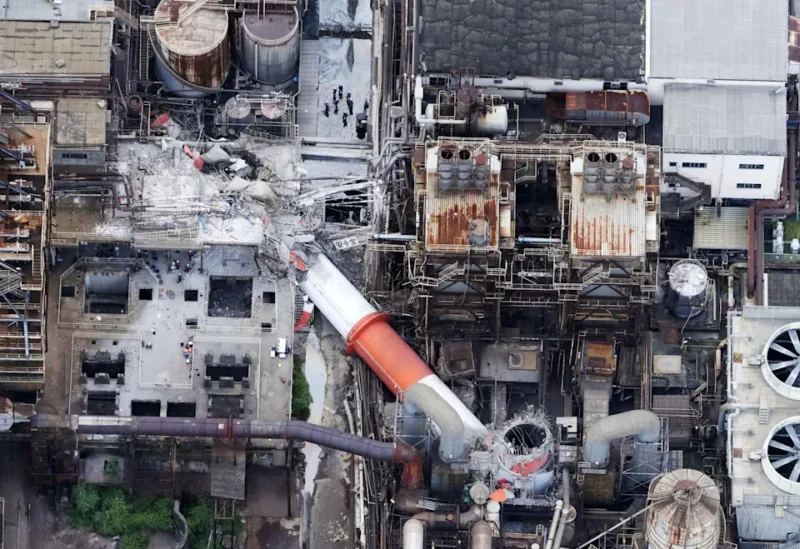
During the earthquake, a large industrial chimney fractured and collapsed onto part of the complex, trapping 11 people.
Seven were pulled from the wreckage. Five of them died, while two suffered injuries classified as moderate. Four others remained unaccounted for.
Police and firefighters continued searching throughout July 29. The company is assessing damage to its equipment and has not been able to say when production may resume.
Unusual for Japan, but not unexpected in Kumamoto
Japan experiences frequent earthquakes because of its position near several tectonic plates and major subduction zones.
Many of Japan’s most powerful earthquakes occur offshore, where one tectonic plate is forced beneath another. The July 28 earthquake, by contrast, was a shallow inland event located close to heavily populated areas.
The Japan Meteorological Agency classified the mechanism as shallow strike-slip faulting, with the pressure axis oriented east-northeast to west-southwest.
An early description in some international media characterised the event as a thrust earthquake, in which one block of rock is pushed upward over another. That account does not match the official Japanese classification or the initial assessment of strike-slip faulting and should therefore not be treated as confirmed.
Inland earthquakes may be smaller than major subduction-zone earthquakes, but they can be more destructive locally because their source is closer to buildings, roads and population centres.
Did the unruptured section from 2016 move?
The earthquake’s source lies near the active Hinagu Fault Zone and within the wider Futagawa-Hinagu geological system associated with the 2016 Kumamoto earthquakes.
Experts had warned for years that some sections of the Hinagu system could represent areas where accumulated geological stress had not been fully released in 2016.
The Hinagu Fault Zone extends for around 81 kilometres in a northeast-southwest direction, from the Mashiki area toward the Yatsushiro Sea.
Japan’s long-term seismic assessments estimate that:
- the inland Hinagu segment could generate an earthquake of around magnitude 7.5;
- the Yatsushiro Sea segment could produce an earthquake of around magnitude 7.3;
- simultaneous rupture of the entire system could produce an earthquake of around magnitude 8.0.
These are long-term seismic scenarios and do not amount to a prediction that a magnitude 8 earthquake will occur in the coming days.
The exact connection between the July 28 earthquake and a specific segment of the Hinagu system must be confirmed through further analysis of the rupture, aftershock distribution and ground deformation.
Ground shifted by up to 87 centimetres
Initial satellite-positioning analysis showed that the Senchō observation point in Yatsushiro had moved about 84 centimetres toward the northeast.
After additional data processing, the Geospatial Information Authority of Japan revised the displacement to approximately 87 centimetres toward the northeast, together with around 32 centimetres of vertical subsidence.
At one point in Kumamoto City, ground displacement of around 40 centimetres toward the north was recorded, while another point in Yatsushiro moved approximately 17 centimetres toward the south.
The authority warned that the measurements may have been affected by tilting of observation points and local deformation, meaning the figures could be revised again.
Around 200 aftershocks within 24 hours
By 4:00 p.m. on July 29, around 200 tremors measuring at least intensity 1 on Japan’s seismic scale had been recorded.
The Japan Meteorological Agency warned that the region has previously experienced cases in which another major earthquake followed the initial shock.
Residents were urged to remain particularly vigilant during the first week and especially during the first two or three days. Authorities have not ruled out another earthquake reaching a maximum seismic intensity of 7.
Because the aftershock zone is extensive, a new earthquake in another part of the fault system could produce locally stronger shaking than that recorded on July 28. A strong offshore earthquake could also create a renewed tsunami risk.
More than 8,800 people in evacuation centres
By the afternoon of July 29, 432 evacuation centres had been opened, sheltering 8,886 people.
Extreme heat quickly became a secondary danger. Temperatures in parts of Kumamoto exceeded 35 degrees Celsius, while power cuts limited the use of air-conditioning.
The government decided to airlift 300 portable cooling units using Self-Defense Force aircraft. Generators, water, food, bread, sanitation equipment and other essential supplies were also being delivered to evacuation centres.
Authorities also warned of the risk of blood clots, commonly referred to in Japan as “economy-class syndrome,” among people sleeping for long periods inside vehicles.
Tens of thousands without electricity and water
At 2:00 p.m., around 34,880 homes and buildings in Kumamoto Prefecture were without electricity. By 7:00 p.m., the number had fallen to around 27,730, indicating that power was gradually being restored.
Different water-supply figures were published because reports covered different times and geographical areas. At midday, around 84,000 households were reported to be without water across Kumamoto and Nagasaki prefectures combined. A later update covering Kumamoto alone placed the number at around 15,000 households.
Seven cities and towns requested 37 water-supply vehicles. The Japan Water Works Association and the infrastructure ministry began dispatching dozens of tanker trucks.
Several hospitals experienced power and water disruptions, while patients from damaged facilities were transferred to other medical institutions.
Railways, motorways and bridges damaged
The Kyushu Shinkansen initially suspended services across its entire route. At 5:15 p.m. on July 29, trains resumed between Hakata and Chikugo-Funagoya.
JR Kyushu aims to reopen the Chikugo-Funagoya–Kumamoto section during July 30. No reopening date has been provided for the Kumamoto–Kagoshima-Chūō section because of broken rails and damage requiring detailed inspections.
Passengers on one train were stranded for around 14 hours before being transported by buses.
Approximately 110.8 kilometres of motorway remained closed, including sections of the Kyushu, Minami-Kyushu and Kyushu Chūō expressways.
Damage was recorded at dozens of locations, including:
- fractured road surfaces;
- major height differences in the carriageway;
- widened cracks and openings;
- damaged bridge joints;
- displaced structural supports.
Particularly serious damage was reported at the Kawata, Katanogawa and Myōken Daiichi bridges.
Aso Kumamoto Airport resumed operations on July 29, although some airlines cancelled flights as a precaution.
Damage to Kumamoto Castle, schools and industry
Stone walls at the historic Kumamoto Castle collapsed at 28 locations, damaging a landmark that was still undergoing restoration after the 2016 earthquake.
At least 16 people were injured in educational institutions: one junior high school student, three high school students, five university students and seven teachers or other staff members.
Two education workers were seriously injured after being trapped beneath a safe. Their injuries reportedly included spinal fractures.
The earthquake also affected the semiconductor industry. TSMC evacuated employees at its Kikuyō plant and began gradually restoring production after finding no serious damage. Tokyo Electron suspended operations at two manufacturing sites for safety inspections, while Honda temporarily halted production at its motorcycle plant.
Delivery companies Yamato and Sagawa restricted parcel acceptance and distribution in affected areas. Many supermarkets, convenience stores and restaurants also suspended operations.
Government promises aid without waiting for local requests
Prime Minister Sanae Takaichi described the rescue effort as a “race against time” and said the government would do everything possible to find those still trapped.
The government activated its proactive support system, under which food, water, toilet paper, cooling equipment and other supplies are delivered without waiting for formal requests from each local authority.
The Self-Defense Forces increased their deployment to around 4,600 personnel and mobilised aircraft, helicopters, water-supply vehicles and medical teams.
Around 1,410 firefighters took part in rescue operations. Of them, 1,139 were deployed as reinforcements from nine prefectures: Okayama, Hiroshima, Yamaguchi, Fukuoka, Saga, Ōita, Miyazaki, Kagoshima and Nagasaki.
Around 800 additional police officers from the Kyushu and Chūgoku regions were requested to support rescue work, traffic control and information gathering.
The United Nations expressed readiness to provide assistance if requested by the Japanese authorities.
What remains unclear?
Although the scale of the disaster is becoming clearer, several fundamental questions remain unanswered.
The exact cause of the explosion. An LPG leak is the leading theory, but the specific pipe, valve or installation where the failure occurred has not been identified.
The ignition source. It is not known whether the gas was ignited by an electrical spark, a device, a switch or another source.
The performance of the safety systems. Investigators must establish whether the valves and automatic meters activated and, if they did, why gas was still able to accumulate.
The presence of employees inside the building. It remains unclear why some people stayed inside or returned after the evacuation.
The final casualty toll. Search operations are continuing at Aeon Mall, the Nippon Paper mill and other damaged buildings.
The responsible fault segment. The Hinagu system is the leading geological explanation, but a final determination requires further analysis of the rupture, aftershocks and ground deformation.
The structural resilience of Aeon Mall. Investigators must distinguish between damage caused directly by the earthquake and destruction caused by the subsequent explosion and fire.
Current situation
By the evening of July 29, the latest confirmed toll stood at at least 18 dead and 62 injured. Seven people remained unaccounted for at the two main search sites: three at Aeon Mall Kumamoto and four at Nippon Paper’s Yatsushiro mill.
Emergency teams are continuing to search the rubble, while authorities work simultaneously to restore electricity, water, transport and healthcare services.
The danger has not passed. Aftershocks, unstable buildings, landslides and extreme heat continue to threaten residents and rescue workers.
The final findings of the investigation into Aeon Mall will be significant far beyond Kumamoto. They are expected to determine whether existing gas shut-off systems are sufficient for large commercial complexes and whether rules governing re-entry into buildings after earthquakes should be revised across Japan./Tetova News