
More than 9,000 flights were delayed and over 440 canceled by 5 p.m. Eastern Time on Friday. Federal officials say there is no evidence of a deliberate attack, but the cause of the unprecedented telecommunications disruption remains under investigation.
WASHINGTON, November 13, 2026 — The Federal Aviation Administration (FAA) ordered a nationwide halt to aircraft departures on Friday afternoon after a major telecommunications failure disrupted the air traffic control network, throwing airports across the United States into turmoil and leaving thousands of passengers facing delays, cancellations and uncertainty.
KEY POINTS
- Nationwide shutdown: The FAA halted flight departures across the United States on November 13, 2026, at approximately 3:53 p.m. ET.
- Massive disruption: More than 9,000 flights were delayed and over 440 canceled by 5 p.m. ET, according to FlightAware figures reported by The Wall Street Journal.
- Communications failure: The disruption affected communications involving 22 regional air traffic control centers.
- No confirmed attack: Homeland Security Secretary Markwayne Mullin said there was no evidence of deliberate sabotage or terrorism, although investigations continued.
- Aircraft already airborne: Flights in progress were allowed to continue, while arriving international flights were handled individually.
- Historic incident: Similar nationwide stops occurred on September 11, 2001, and January 11, 2023.
- Unanswered questions: The technical cause, exact restoration timetable and ultimate impact on weekend travel remained unconfirmed in the latest verified reports.
The extraordinary ground stop began at approximately 3:53 p.m. Eastern Time (9:53 p.m. Central European Time), with the FAA citing safety concerns and extraordinary circumstances.
By 5 p.m. Eastern Time, more than 9,000 flights had been delayed and over 440 canceled, according to FlightAware data reported by The Wall Street Journal.
The disruption affected communications involving the nation’s 22 Air Route Traffic Control Centers, which coordinate aircraft movements across large portions of American airspace.
The FAA allowed aircraft already airborne to continue toward their destinations, while international flights arriving in the United States were to be handled individually.
Transportation Secretary Sean Duffy confirmed that FAA technicians were investigating the communications problem.
Homeland Security Secretary Says There Is No Evidence of an Attack
Homeland Security Secretary Markwayne Mullin told reporters at the White House that officials had found no indication of a deliberate attack.
“There was no indication as of yet that this was a nefarious attack against us,” Mullin said, describing the situation as a telecommunications outage.
He emphasized that investigators were not excluding any possible cause, including a cyberattack, while making clear that no evidence had established such a connection.
“This isn’t another 9/11,” Mullin said, seeking to reassure travelers concerned about the nationwide shutdown.
President Donald Trump had been briefed on the situation, according to reports citing administration officials.
Mullin warned that restoring normal operations would take time and that the technical problems could not necessarily be resolved within an hour.
Officials said aircraft already in flight had been accounted for and emphasized that passengers were not facing an identified immediate threat.
Thousands of Flights Delayed, Hundreds Canceled
The scale of the disruption became evident almost immediately.
FlightAware reported more than 9,000 delays and over 440 cancellations by 5 p.m. Eastern Time. Earlier figures had already shown thousands of disrupted flights as the shutdown spread across the national aviation network.
According to flight-tracking application Flighty, more than 30,000 departures and arrivals had been scheduled for the remainder of Friday when the nationwide ground stop began.
At the beginning of the shutdown, Flightradar24 reported that more than 1,000 aircraft were airborne and heading toward American airports.
These figures represent different measures of aviation activity and should not be interpreted as the number of canceled flights or aircraft stranded on the ground.
Aviation specialists warned that even a relatively short interruption could have consequences lasting well beyond the initial shutdown.
Aircraft and crews could end up out of position, while pilots and flight attendants might reach legally permitted working-hour limits. This could force airlines to cancel additional services and disrupt weekend travel.
Passengers Removed From Aircraft at Major Airports
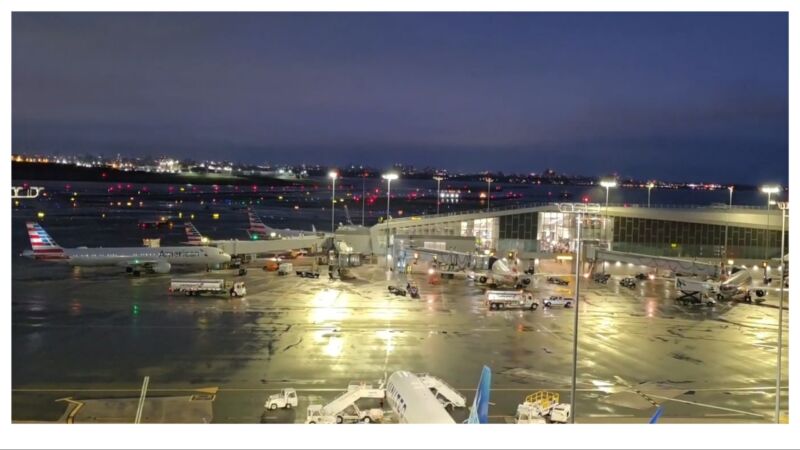
At Chicago’s O’Hare International Airport, passengers reported remaining aboard aircraft for extended periods as departure clearances were suspended.
One United Airlines pilot operating a flight to Rochester, New York, told passengers that he did not know whether departures would resume that day.
After attempting to return to the terminal, the crew encountered another problem: congestion had left some aircraft without available gates.
Barbara Bullock, traveling from Colorado to upstate New York with her 17-year-old daughter for college visits, described the frustration of coming close to departure only to have the journey halted.
At Denver International Airport, passengers were removed from aircraft with their luggage. Some began arranging alternative flights for the following day, while others waited for information from airline representatives.
At Asheville Regional Airport in North Carolina, passengers were reportedly told that no further updates were expected before midnight. Airport personnel returned checked luggage and advised travelers to go home.
Disruption was also reported at New York’s LaGuardia Airport, where travelers queued to cancel bookings or seek refunds.
Airlines Warn of Continuing Disruptions
Major American carriers issued statements acknowledging the nationwide shutdown.
United Airlines said aircraft already in the air could continue their journeys, but new domestic departures would remain suspended while the FAA’s order was in force.
American Airlines warned that its schedules could be disrupted for the remainder of Friday, depending on how long the ground stop lasted.
The carrier said its teams would work to resume passenger journeys as quickly as possible once the restrictions were lifted.
Travelers were advised to check airline applications, official notifications and flight-status information before traveling to airports.
Even after operations resume, airlines may need additional time to reorganize schedules, reposition aircraft and crews, and accommodate passengers affected by cancellations.
The Third Nationwide Shutdown in Decades
Friday’s ground stop was an exceptionally rare event in American aviation history.
The FAA previously halted departures nationwide on September 11, 2001, following the terrorist attacks on New York and Washington.
Another nationwide departure suspension occurred on January 11, 2023, after a failure in the Notice to Air Missions system, known as NOTAM, which provides essential safety information to pilots.
That disruption lasted approximately 90 minutes to two hours, according to different accounts of the shutdown and its operational recovery, and contributed to widespread flight cancellations and delays.
The 2026 incident therefore represents the third such nationwide interruption in recent decades, including the September 11 shutdown.
Aging Communications Infrastructure Under Scrutiny
The latest breakdown has renewed attention on longstanding vulnerabilities in the American air traffic control system.
In recent years, telecommunications, radio and radar failures have disrupted operations at several FAA facilities, including centers serving New York, Dallas and the Upper Midwest.
Earlier in 2026, an incident involving damage to a fiber-optic communications line in New Jersey interrupted flights serving New York-area airports.
The federal government has been pursuing a major modernization program intended to replace outdated communications equipment and improve the resilience of the national air traffic control network.
Congress approved approximately $12.5 billion in 2025 for modernization efforts, while Transportation Secretary Duffy has estimated that roughly another $30 billion will be needed to complete the broader overhaul.
The Associated Press also reported that investigators would examine whether a recently introduced air traffic management system involving artificial intelligence had any connection to Friday’s disruption.
No causal link between that technology and the outage has been established.
It also remained unclear whether the failure affected only voice communications between controllers and pilots or extended to radar systems used to maintain safe separation between aircraft.
What Remains Unknown
As of the latest verified reports reviewed for this article, authorities had not publicly identified the precise technical cause of the nationwide outage.
Investigators had not established that the incident resulted from sabotage, terrorism or a cyberattack.
Although the FAA’s original nationwide order was confirmed, a subsequent official announcement lifting the restriction could not be independently verified at the time of this report.
The confirmed operational figures also remained time-specific: more than 9,000 delays and over 440 cancellations as of 5 p.m. Eastern Time. They should not be treated as a final tally.
The central unanswered questions are what caused the communications breakdown, how quickly normal air traffic operations can be restored, and whether the disruption will produce cascading cancellations across the weekend.
The incident has demonstrated how a failure in critical aviation communications infrastructure can rapidly affect air travel across an entire country.
(Sources: Federal Aviation Administration, U.S. Department of Transportation, Associated Press, Reuters, The Wall Street Journal, The New York Times, FlightAware, Flighty, Flightradar24)