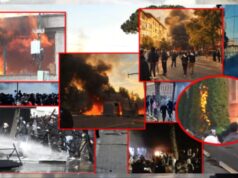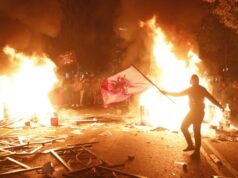

TIRANA, Albania, October 14, 2026 – Albania’s capital has experienced two days of violent protests marked by attacks on government institutions, arson, destruction of public and private property, clashes with security forces, and dozens of people injured or detained. What began as a student-led protest over education and living conditions has evolved into a broader movement against Prime Minister Edi Rama’s government, triggering widespread unrest across several major areas of Tirana.
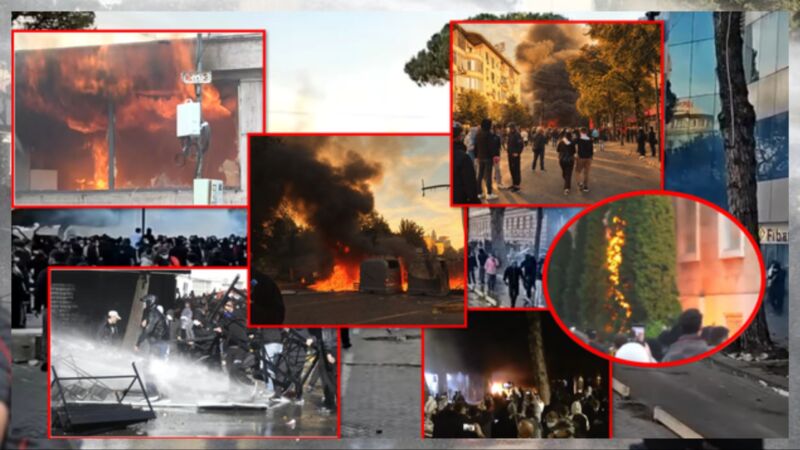
On Wednesday, October 14, groups of protesters moved from the Ministry of Education toward other government institutions, attacking state buildings, banks and businesses with stones, firecrackers, fireworks and Molotov cocktails.
In several incidents, masked individuals entered government buildings, smashed doors and windows, removed furniture and set fires.
Albanian State Police responded with tear gas and water cannons, while clashes continued for hours and spread to different parts of the capital.
According to TV Klan’s report at 10:55 p.m., Interior Minister Ervin Demo stated that 51 police officers had been injured during the protests, with several receiving medical treatment at the Military Hospital.
Meanwhile, Euronews Albania reported that approximately 70 people had been detained at Police Station No. 1, although that figure had not yet been officially confirmed as the final detention count.
From Student Demands to Calls for the Government’s Resignation
The protests on October 13 and 14 began with mobilization among Albanian university students dissatisfied with academic conditions, tuition fees, student accommodation, the cost of living and limited employment opportunities after graduation.
Students have also expressed frustration over insufficient financial assistance and wider social inequalities.
The first demonstration, held on October 13 outside the Ministry of Education, drew students and other citizens into protests that continued until the evening.
However, protesters’ demands extended beyond education.
Demonstrators chanted slogans calling for the resignation of Prime Minister Edi Rama, the removal of his government and broader political change.
According to Radio Free Europe/Radio Liberty, some protest organizers have demanded the establishment of a transitional technical government and the holding of free and fair elections.
On Wednesday, students from additional university faculties joined the demonstrations, including those studying medicine, economics, law and engineering at Tirana’s Polytechnic University.
Pupils from several Tirana high schools, including Partizani High School, boycotted classes, while students at the Faculty of Foreign Languages in Shkodër staged a solidarity boycott.
Ministry of Education Becomes the Epicenter of Clashes
Wednesday’s tensions began outside the Ministry of Education, where protesters gathered during the morning, despite the demonstration originally being scheduled for 2:00 p.m.
Some young demonstrators tore down metal roadside barriers, damaged traffic signs and threw stones and other objects toward the ministry building and police officers.
Firecrackers, fireworks and incendiary devices were also thrown toward security personnel.
Flames and thick smoke were reported within the ministry premises, prompting police to deploy tear gas and water cannons to disperse the crowd.
Journalists at the scene reported that some masked protesters attempted to enter the building, while police sought to prevent them from breaking through security lines.
International news agency Reuters reported that a fire broke out at the Ministry of Education during the demonstrations, while financial institutions were also seriously damaged, including a Raiffeisen Bank branch.
Ministries of Economy, Finance and Interior Targeted
Following the clashes outside the Ministry of Education, groups of protesters moved toward central Tirana.
One of their main targets was the Ministry of Economy, where demonstrators smashed doors and windows, entered the ground floor and carried furniture outside.
Other reports described incidents at the Ministry of Finance, where objects were damaged and fires were started.
The Ministry of Interior was also attacked, with protesters throwing stones at the building and damaging windows and parts of its exterior.
Near the Central Election Commission, demonstrators reportedly attempted to enter the institution, although there was no confirmation that they had taken control of the building.
Traffic lights, road signs, barriers, benches and other public infrastructure were damaged in several parts of the capital.
Prime Minister’s Office Attacked with Stones and Molotov Cocktails
On Wednesday afternoon, demonstrators moved toward Dëshmorët e Kombit Boulevard, where some of the fiercest confrontations took place.
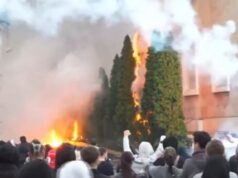
Stones and Molotov cocktails were thrown toward the Prime Minister’s Office.
A tree near the government building caught fire, sending smoke into the surrounding area.
Police deployed water cannons and tear gas to push back demonstrators, while security forces maintained protective cordons around the building.
At several points, protesters dispersed into smaller groups before returning to the vicinity of government institutions.
Clashes also continued near the parliamentary administration building and the Constitutional Court.
Parliamentary Entrance Damaged as Protesters Approach Electoral Commission
Protesters also moved toward the building housing Parliament’s administrative offices and the Constitutional Court.
According to reports, one of the entrance doors was broken, while several demonstrators attempted to get inside.
Police intervened with tear gas, preventing the crowd from advancing further.
Parliament Speaker Niko Peleshi condemned the attacks on state institutions, saying violence and destruction did not serve the public interest.
Further confrontations were reported near the Central Election Commission, where protesters attempted to enter the building.
Tirana Pyramid, Twin Towers, Banks and Businesses Hit by Violence
Considerable damage was also recorded around the Pyramid of Tirana, one of the capital’s best-known landmarks.
Protesters smashed windows and damaged various premises, while fires were reported nearby.
The situation escalated near the complex known as the Twin Towers, where several businesses on the lower floors were attacked and set ablaze.
Television footage showed thick smoke and flames as police and firefighters attempted to intervene.
Banks and financial institutions in other parts of Tirana also came under attack.
In several cases, windows were smashed, doors damaged and business premises set on fire.
A shopping center near Tirana Castle was also affected by the evening unrest, with reports of broken windows.
Ministry of Justice Set on Fire, Free Legal Aid Office Destroyed
Another serious incident occurred at the Ministry of Justice.
Protesters attacked the building with stones and incendiary devices, broke windows and started a fire on the ground floor.
Justice Minister Toni Gogu confirmed that the free legal aid office had been burned.
The public service provides legal assistance to citizens who cannot afford to hire a lawyer.
According to the minister, no employees were injured in the incident.
Gogu said the destruction directly affected vulnerable citizens, including pensioners, single mothers, young people and victims of violence.
He announced that free legal aid services would continue despite the damage.
Police Vehicle Set Ablaze Outside Police Station No. 2
One of the evening’s most serious incidents occurred near Police Station No. 2 in Tirana.
At approximately 9:00 p.m., a group of protesters gathered outside the police station and attacked the premises.
According to reports from the scene, windows were smashed and several individuals attempted to enter the building.
During the unrest, a police patrol vehicle was set on fire.
Firefighters and additional police units arrived at the scene, while several protesters were reportedly detained.
Further tensions were reported on Elbasan Street, where businesses were attacked and objects were set ablaze.
Fires were also started near the Zogu i Zi intersection, while benches, rubbish bins and other materials were burned around Skanderbeg Square.
Euronews Albania also reported that the ground floor of a tower under construction at the beginning of Durrës Street caught fire.
Firefighters experienced difficulties reaching the building because of obstacles and debris scattered across the road.
Interior Minister Reports 51 Injured Police Officers
The reported number of injured and detained people changed several times throughout Wednesday.
At 8:48 p.m., Albanian State Police announced that 14 officers had been injured and 35 people had been taken into custody in connection with the incidents.
According to a Ministry of Health update at 9:26 p.m., 29 people were receiving treatment at the Trauma Hospital: 23 police officers, five protesters and one passerby.
Later, at 10:55 p.m., Interior Minister Ervin Demo stated, according to TV Klan, that the number of injured police officers had risen to 51.
Several officers were receiving medical care at the Military Hospital.
One 31-year-old officer, identified by the initials L.D., reportedly suffered serious eye injuries and fractures to his jaw and nose.
Meanwhile, Euronews Albania reported approximately 70 detainees at Police Station No. 1, although this remained a media report rather than a final official arrest figure.
The number of injured and detained individuals may change as authorities complete their assessments.
October 13 Protest: 16 Arrested and 49 Facing Criminal Proceedings
Wednesday’s protests followed the previous day’s unrest, when clashes began outside the Ministry of Education and spread to other areas of Tirana.
According to an official statement from Tirana Police, 16 people were arrested and criminal proceedings were initiated against another 49 individuals in connection with the October 13 incidents.
Police reported that six officers had been injured during Tuesday’s demonstration.
Those arrested are suspected of offenses including assault in connection with official duties, disturbing public order, property destruction, arson and violations involving explosive or incendiary substances.
These figures relate specifically to October 13 and must not be confused with the figures from the October 14 protest.
Allegations of Police Violence Investigated; Five Officers and Supervisors Suspended
Alongside the attacks on public institutions, the protests have raised concerns about the methods used by Albanian State Police.
Following the release of footage involving a 19-year-old man injured during a police intervention, authorities launched an investigation into the conduct of officers.
Police announced the suspension of four officers and the head of public order at Police Station No. 1, while the Police Oversight Agency and prosecutors opened investigations.
The full circumstances surrounding the young man’s injuries remain under investigation.
Concerns have also been raised regarding the treatment of journalists, following reports of a female journalist being injured and television crews being obstructed while covering the demonstrations.
Authorities have been urged to ensure journalists’ safety and respect citizens’ rights during police operations.
European Union Calls for Investigation into Alleged Excessive Police Force
The European Union Delegation to Albania expressed concern over the escalation of violence in Tirana.
The EU emphasized that freedom of assembly and expression are fundamental rights that must be respected.
In its statement, the delegation said it was aware of allegations of excessive police force against protesters and journalists.
It called for police actions to remain proportionate and for allegations of misconduct to be investigated as a priority.
The German Embassy endorsed the EU delegation’s position.
The British Embassy also emphasized that the right to protest does not justify violence or the destruction of property, while warning that police interventions must not be disproportionate.
Meanwhile, the US Embassy in Tirana issued a security alert advising American citizens to avoid protest areas due to the risk of clashes and traffic disruptions.
President Begaj Calls for Calm and Responsibility
Albanian President Bajram Begaj expressed concern over the escalation of unrest and called on all parties to act responsibly and exercise restraint.
He emphasized that peaceful protest is a fundamental democratic right, but that violence cannot be used as a means of expressing dissatisfaction.
Begaj also stressed that police use of force must comply with the law and the principle of proportionality.
The president said his office remained open to hearing the concerns of young people and other citizens.
Rama and Government Condemn Violence; Berisha Demands Resignation
Prime Minister Edi Rama and government representatives condemned the violence, emphasizing that people attacking institutions and destroying property did not necessarily represent students or their legitimate demands.
According to Euronews Albania, Rama told a government meeting that those responsible for the violence were not students.
Interior Minister Ervin Demo accused political forces and other individuals of attempting to exploit the demonstrations for political purposes.
He warned that those involved in attacks against police and the destruction of public and private property would face legal consequences.
Meanwhile, Democratic Party leader Sali Berisha accused the government of using excessive force against demonstrators and demanded Rama’s immediate resignation.
Berisha said the Democratic Party would continue supporting the students through all available means.
However, according to several media reports, some students and other demonstrators opposed the presence of opposition politicians, insisting that the movement should not be identified with political parties.
From the Flamingo Revolution to the Student Uprising
The October 13 and 14 protests unfolded against a broader background of social and political dissatisfaction in Albania.
For several months, demonstrations connected to the movement known as the Flamingo Revolution had been taking place in Tirana.
The movement initially focused on opposition to a luxury tourism project in the protected coastal area of Zvërnec.
The project is linked to investments backed by Jared Kushner, son-in-law of US President Donald Trump, and has generated controversy over environmental protection, land ownership and economic interests.
Over time, the movement expanded to include criticism of alleged corruption, economic inequality and government policies.
The October student protests took place within this wider political context and received support from participants in the broader anti-government movement.
Nevertheless, the demonstrations brought together a diverse range of participants, and available information is insufficient to establish that all protesters belonged to the same organizations.
International Media Turn Attention to Tirana
The events in Tirana have received extensive coverage from international news organizations.
Reuters reported on the escalation of student demonstrations, fires at public institutions and banks, and the mounting political challenge facing Prime Minister Edi Rama’s government.
The Associated Press connected student mobilization with the wider anti-government movement, while Al Jazeera and Euronews covered the violent confrontations and concerns regarding protesters’ rights.
International reporting has highlighted how student dissatisfaction over education, living costs and economic prospects has become intertwined with demands for political change.
From the 2018 Student Protests to the October 2026 Escalation
Albania has previously experienced major student protests.
In December 2018, thousands of students took to the streets to oppose university fees, poor accommodation conditions and other problems in higher education.
The government introduced several measures, including changes to tuition fees, but some grievances remained unresolved, according to organizers of the current demonstrations.
Unlike the 2018 protests, which focused primarily on educational policy, some organizers of the October 2026 movement have openly declared that their objective is the removal of the government.
This has broadened the political dimension of the protests and intensified tensions between the government, the opposition and various groups of demonstrators.
Tirana After Two Days of Protests: Extensive Damage and Ongoing Investigations
After hours of clashes, most protesters began dispersing from central Tirana at approximately 10:00 p.m. on Wednesday.
The two days of demonstrations left considerable damage to government institutions, banks, private businesses, vehicles, traffic lights and road infrastructure.
Authorities have opened investigations to identify those responsible for the attacks, while inquiries into allegations of excessive police force are also ongoing.
The final number of injured people, arrests and the full extent of material damage remain to be determined.
Meanwhile, the protests of October 13 and 14 have highlighted a wider crisis of trust between sections of Albania’s younger generation and state institutions.
It remains unclear whether the demonstrations will continue with the same intensity, spread to other cities or lead to attempts at dialogue between students and the government.
What is clear is that two days of unrest have marked a significant escalation in Albania’s political and social tensions, placing Tirana at the center of national and international attention.
Sources: Albanian State Police, Ministry of Health, Top Channel, TV Klan, RTSH, A2 CNN, Euronews Albania, Report TV, Radio Free Europe/Radio Liberty, Reuters, Associated Press, BIRN and Al Jazeera.